


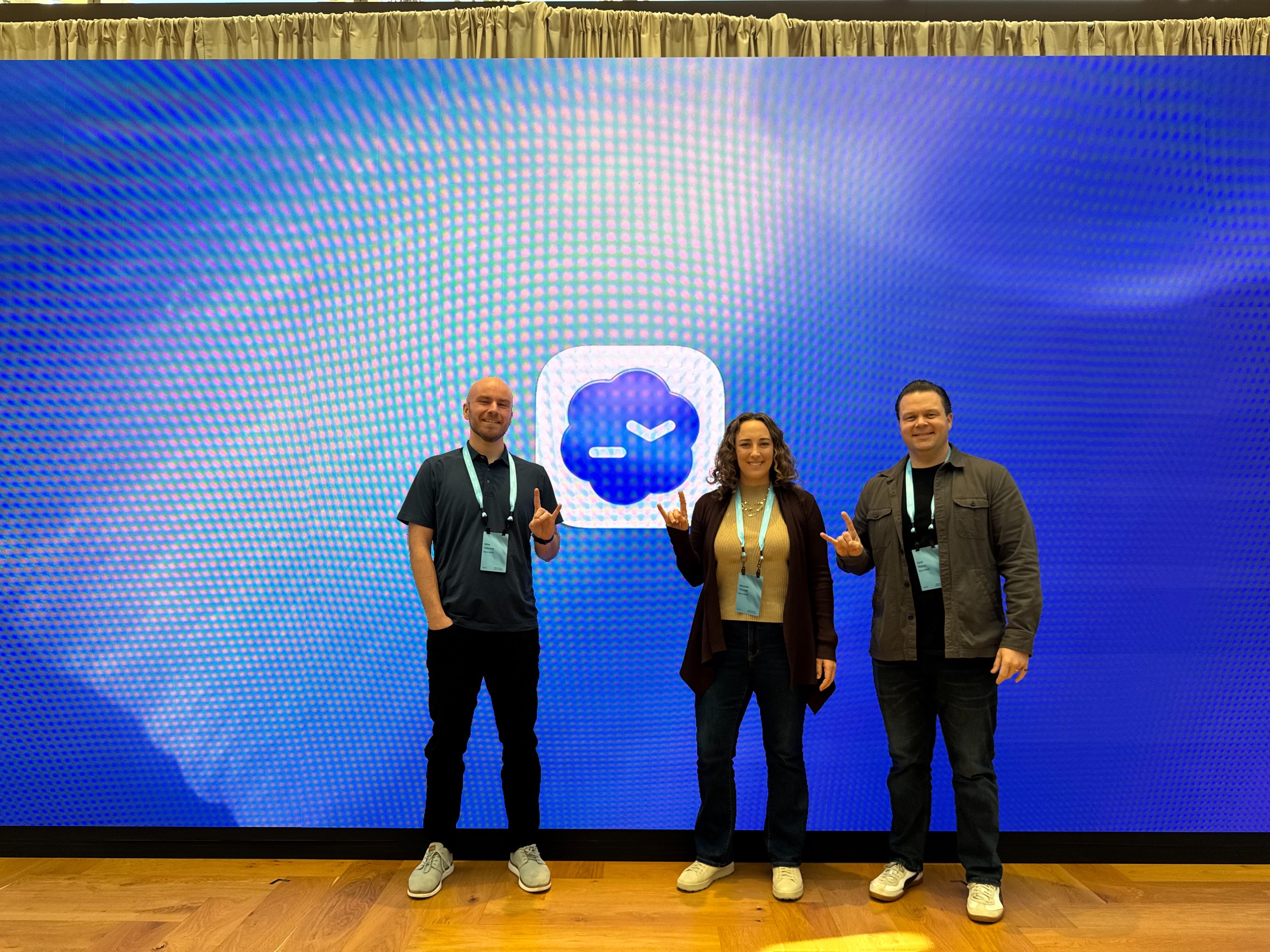
There were thirty teams competing at OpenAI’s Global Codex Hackathon, and our website crawler won us fourth place. Here’s a look back at how the day went, from three different perspectives: Mike Osborne (AI Engineer), Michelle Thorsell (Full-Stack Engineer), and Zack Naylor (AI Strategist/Product Lead).
What we built
Our goal was to build an idea we came up with called App Mapper, a Codex-powered website crawler that maps every page and user flow of a site as an interactive visual, something product teams have traditionally done by hand.
By the end of the day, we had a tool that crawls a site, generates an interactive flow map, scores each page against well-established usability heuristics, flags severity of issues, surfaces recommended changes, and exports a PowerPoint deck with findings ready to share with a client.
How we divided the work
Mike worked on the functional bones of the project: a Next.js app, no database (because there was no time for migrations), deployed to Vercel for quicker feedback. Michelle was in charge of UI/UX. She developed an elegant interface that was intuitive to use. A polished UI was integral to the project, because one of the objectives of the hackathon was to highlight the scope of Codex’s capabilities, including the aesthetic ones.
Zack started in a support position, guiding product direction and troubleshooting. “I figured they’d end up doing most of it,” he shares. “I was ready to contribute but honest with myself about how much I’d actually be needed given the caliber of the engineering team.” However, his role ended up evolving significantly over the course of the hackathon.
The walls we hit
At one point, the app got stuck in a loop that kept crashing everyone’s computers. The solution ended up being fairly straightforward: we prompted Codex with the problem and explicitly told it not to run the app until it had resolved the issue.
The biggest technical blocker, however, was the crawl. Getting the app to reliably map even one site took a lot of trial and error. About halfway through the day, the team decided to restrategize: find one site that produces a usable crawl and build around that. That open source site ended up being Formbricks.
When it clicked
The project really started to feel “real” once it was reliably running crawls and the interactive map was live. “It wasn’t just ‘the build is working,’” Michelle reflects. “It was the realization that we’d actually automated something product teams do by hand.”
This is when Zack’s role began to shift. With the core product stable, he suggested adding a scoring layer to the map that would rate each page against usability heuristics, flag severity, and surface recommended changes. Even though he has minimal coding experience, he was able to use Codex to build a feature that exports those findings into a client-ready PowerPoint deck.
“That surprised me most,” shares Mike. “The fact that Zack was able to quickly contribute our killer feature—with little to no coding background—that speaks to Codex’s strengths.”
How we kept it on track
Michelle was continually monitoring how much time there was left. "Done beats impressive-but-broken. An amazing feature that wasn't complete wouldn't help us at judging. A demoable, polished product would," she asserts. That meant cutting and deprioritizing along the way, not because the ideas weren't good, but because the goal was to have features that both functioned and demoed well.
What we took away
All three of us were surprised by how much got done. In just four hours, we had built a functioning product from zero, and still had enough time left to practice our demo. But our biggest takeaway is about what delegating efficiently made possible for our team. Our product lead was able to take charge of feature work using a tool he’d never touched before, because our engineers made strategic stack choices to give AI the best chance to perform.
Mike put it plainly: “Codex challenges the experience you used to need. A product or design skillset can now run really quickly and then hand it off to an engineer. It enables a new way of working.”
“If you’re confident in the team around you and you have the right tools in place, you’d shock yourself with how much you can do under extremely tight timelines,” Zack adds.
Michelle notes: “We walked away with something actually useful, with enough time left to practice our demo. I don’t think any of us expected to feel that good about the output at the end of it.”
If you’re reading this and it sounds like your kind of work
We're a lean, senior organization filled with teams like this – a product lead and a couple of AI engineers. If you want to work with people who move fast and take the craft seriously, we'd like to talk.